Interesting videos dedicated to the Bay of Pigs invasion and its main participants.

Affichage des articles dont le libellé est Fidel Castro. Afficher tous les articles
Affichage des articles dont le libellé est Fidel Castro. Afficher tous les articles
Consequences
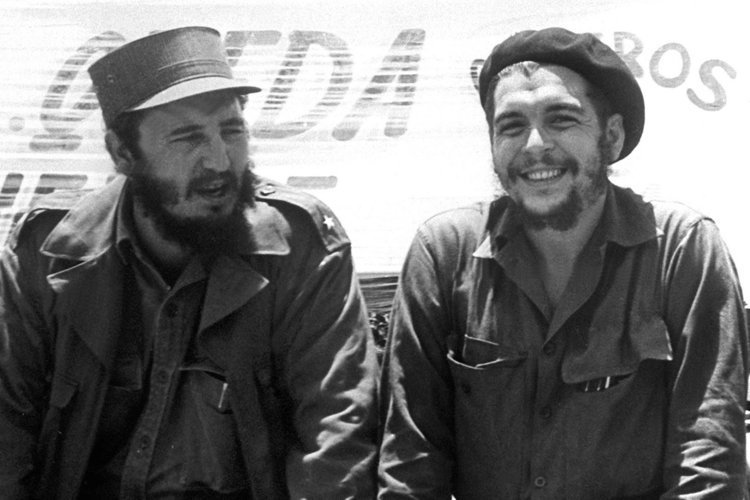 |
| Fidel Castro & Che Guevara |
The invasion is recognized as
making Castro (and Guevara) even more popular... The revolution "Marxist-Leninist" was declared and Cuba pursued closer relations with the Soviet Union, that helped pave the way for the 1962 Cuban Missile Crisis. Castro was increasingly wary of further US intervention, and more open to Soviet suggestions of placing nuclear weapons on Cuba to ensure its security.
You'll find more information about the Cuban Missile Crisis on Florian Jassogne's blog on the subject !
You'll find more information about the Cuban Missile Crisis on Florian Jassogne's blog on the subject !

The Invasion
Invasion day (17 April 1961)
On April 17, 1961 about 1300 exiles, armed with US weapons, landed at the Bahía de Cochinos on the southern coast of Cuba. Hoping to find support from the local population, they intended to cross the island to Havana...
During the night, a diversionary landing was organized in Cuba. A flotilla of small boats containing equipment (that was the source of Cuban reports that briefly lured Fidel Castro away from the Bay of Pigs battlefront).
At about 00:00, two CIA LCIs entered the Bay of Pigs on the southern coast of Cuba. They headed a force of four transport ships, carrying Cuban exile troops plus tanks and other vehicles.
At about 00:00, two CIA LCIs entered the Bay of Pigs on the southern coast of Cuba. They headed a force of four transport ships, carrying Cuban exile troops plus tanks and other vehicles.
At about 01:00, the battlefield command ship directed the principal landing at Playa Girón.
At daybreak, three FAR Sea Furies started attacking the ships still unloading troops. About 270 troops had been unloaded, but about 180 survivors were incapable of taking part in further action because of the loss of their weapons and equipment.
At about 07:00, two invading FAL B-26s attacked and sank the Cuban Navy Patrol Escort ship.
At about 07:30, 177 paratroops were dropped. About 30 men, plus heavy equipment, were dropped to block the roads. Those positions were maintained for two days, reinforced by ground troops from Playa Girón.
By 09:00, Cuban troops and militia from outside the area had started arriving. Throughout the day they were reinforced by more troops and heavy armour.
At about 07:30, 177 paratroops were dropped. About 30 men, plus heavy equipment, were dropped to block the roads. Those positions were maintained for two days, reinforced by ground troops from Playa Girón.
By 09:00, Cuban troops and militia from outside the area had started arriving. Throughout the day they were reinforced by more troops and heavy armour.
At about 11:00, Fidel Castro issued a statement saying that the invaders, members of the exiled Cuban revolutionary front, have come to destroy the revolution and take away the dignity and rights of men.
By 16:00, Fidel Castro had arrived at the battlefield.
It was evident from the first hours of fighting, that the exiles were going to lose. President Kennedy had the option of using the US Air Force against the Cubans but decided not to do it. Consequently, the invasion was stopped by Castro's army.
It was evident from the first hours of fighting, that the exiles were going to lose. President Kennedy had the option of using the US Air Force against the Cubans but decided not to do it. Consequently, the invasion was stopped by Castro's army.
 |
| The Bay of Pigs invasion - President Kennedy with some US officers |
Invasion day plus one (D+1) 18 April
By about 10:30 on 18 April, Cuban troops and militia took Playa Larga. Fidel Castro re-located to that battlefront area.
At about 17:00, B-26s piloted by CIA pilots attacked a Cuban column. The vehicles were loaded with civilians, militia, police and soldiers.
During the night of 18 April, a FAL C-46 delivered arms and equipment to the Girón airstrip and took off before daybreak.
Invasion day plus two (D+2) 19 April
The final air attack mission failed : American planes were shot down. Combat air patrols were flown. American troops retreated.
Late that day, destroyers USS Eaton and USS Murray moved into Cochinos Bay to evacuate retreating Brigade soldiers from beaches.
Invasion day plus three (D+3) 20 April
Reconnaissance flights were sent. Planes searched the coastline and survivor were rescued. 90 exiles had been killed and the rest had been taken as prisoners.
The Bay of Pigs invasion : political background
Political background
Before being president of the USA, John F. Kennedy was a democratic senator from Massachusetts. He won the 1960 presidential election and had already some "enemies"...
First, the former president Eisenhower himself : Eisenhower always considered John Kennedy too young and inexperienced to be a
serious president (He referred to him as "the boy"
and "young whippersnapper"). When Kennedy won
the election, Eisenhower considered it as his own greatest defeat. He abhorred
Kennedy's big spending as president and his passive response to the building
of the Berlin Wall. He also called the new president's challenge to race the
Russians to the moon a "stunt".
On March
1960, Eisenhower approved a program of covert action against the castro regime. The objective was presented as follows : to replace the Castro regime with one more devoted to the true interests of
the Cuban people and more acceptable to the USA, in such a manner to avoid any
appearance of US intervention. On August of the same year, Eisenhower approved a budget of $13 million for the
operation. On November 1960, directors of the CIA briefed new president John Kennedy on
the plans and Eisenhower persuaded him of their merit.
 |
| USA presidents Dwight Eisenhower and John Fitzgerald Kennedy |
Than, the Cuban leader Fidel Castro : President John F. Kennedy stood against him in order to keep the United States safe. Looking into the Kennedy foreign policy towards Cuba demonstrates how he believed that Castro’s regime was a very important player in the Cold War. For some American people, Kennedy was obsessed with Castro : why would he waste his time focusing on the tiny island of Cuba? How would the world perceive the United States when they feared a dictator? Was it because they were so close to US soil? Or was removing Castro a way to show the USSR that he was in control?
 |
| Cuban leader Fidel Castro (left) and US president John Fitzgerald Kennedy (right) |
The Bay of Pigs invasion : background information
Bay of Pigs invasion
The Bay of Pigs invasion was an action launched by the CIA to overthrow the Cuban government of Fidel Castro. The invasion took place in April 1961, in southern Cuba (on the Bay of Pigs) and the American forces were actually composed of Cuban exiles, trained by the CIA.
The action was unsuccessful : the Cuban armed forces (trained and equipped by Eastern Bloc nations) defeated the invading combatants within three days, unfortunately for John Fitzgerald Kennedy who was on his first months of presidency…
 |
A map of the famous Bay of Pigs, in Cuba |
Title explanation
The main invasion took place at a Cuban beach named Playa Girón. The
invasion is named after the Bay of Pigs, (although that is only a
translation of the Spanish Bahía de Cochinos) which was a part of this
beach.
This Cuba beach had been choosen because of its good port facilities, but also because it was closer to many existing counter-revolutionary activities, because it was had an easily defensible beachhead, and because it offered an escape route into the mountains.
Inscription à :
Articles (Atom)