Menu déroulant

Affichage des articles dont le libellé est Invasion failure. Afficher tous les articles

What about the Cuban exiles ?

Cuban exiles made prisoners by Castro's men after the invasion failure

Cuban exiles from Brigade 2506 were killed in action, and some of the survivors were made prisoners : wounded and sick prisoners were freed and transported to the USA, but hundreds of prisoners were executed by the Cuban government after a short trial
In May 1961, Fidel Castro proposed to exchange the remaining survivors for 500 large farm tractors, valued at US $28 million. An agreement was finally found and 1, 113 prisoners were exchanged for US $53 million in food and medicine, sourced from private donations.
On 29 March 1962, 1,179 Cuban exiles were put on trial for treason. They were sentenced to 30 years in prison.
On 29 December 1962, President Kennedy and his wife Jacqueline attended a "welcome back" ceremony for Brigade 2506 veterans at the Orange Bowl in Miami, Florida.

Many who fought for the CIA in the conflict (and were rescued by American airplanes after the invasion failure) remained loyal to the USA : some Bay of Pigs veterans became officers in the US Army in Vietnam !

Consequences

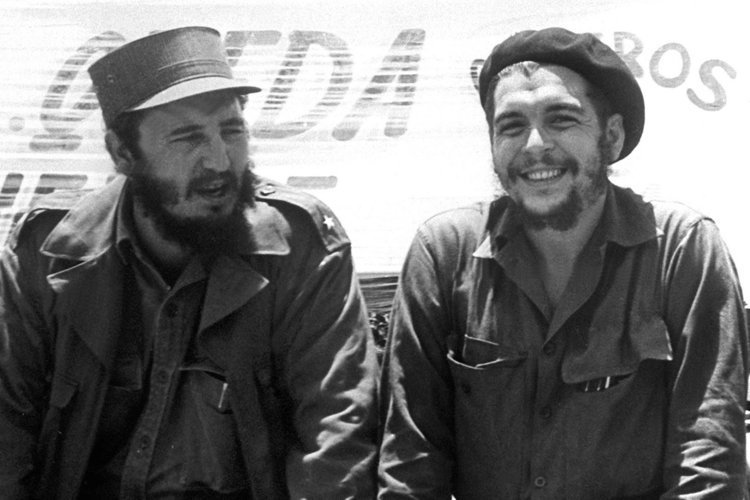
Fidel Castro & Che Guevara
The invasion is recognized as making Castro (and Guevara) even more popular... The revolution "Marxist-Leninist" was declared and Cuba pursued closer relations with the Soviet Union, that helped pave the way for the 1962 Cuban Missile Crisis. Castro was increasingly wary of further US intervention, and more open to Soviet suggestions of placing nuclear weapons on Cuba to ensure its security.

You'll find more information about the Cuban Missile Crisis on Florian Jassogne's blog on the subject !

Trying to understand the failure...

After many studies,the failure was attributed to lack of early realization of the impossibility of success by covert means, inadequate aircraft, limitations of armaments, pilots and air attacks to attempt plausible deniability, and ultimately, loss of important ships and lack of ammunition...


The CIA report

In November 1961, CIA inspector general Lyman B. Kirkpatrick, authored a report that remained classified top secret until 1996. Conclusions were that :
  • The CIA exceeded its capabilities in developing the project from guerrilla support to overt armed action without any plausible deniability.
  • Failure to realistically assess risks and to adequately communicate information and decisions internally and with other government principals.
  • Insufficient involvement of leaders of the exiles.
  • Failure to sufficiently organize internal resistance in Cuba.
  • Failure to competently collect and analyze intelligence about Cuban forces.
  • Poor internal management of communications and staff.
  • Insufficient employment of high-quality staff.
  • Insufficient Spanish-speakers, training facilities and material resources.
  • Lack of stable policies and/or contingency plans.

Political reactions

  • John F. Kennedy

The failed invasion severely embarrassed the Kennedy Administration ! On 21 April, in a press conference, President Kennedy said: "There's an ode saying that victory has a hundred fathers and defeat is an orphan... What matters is only one fact, I am the responsible officer of the government." 
President Kennedy was angered with CIA's failure, and declared he wanted "to splinter the CIA in a thousand pieces and scatter it to the wind."
Determined to make up for the failed invasion, the administration initiated Operation Mongoos : a plan to sabotage and destabilize the Cuban government and economy. The plan included the possibility of assassinating Castro. Almost 50 years later, relations between Castro's Cuba and the United States remain strained and tenuous.

President Kennedy with wife Jackie and Officers during a press conference
  • Cuban reactions

The invasion failure made Castro wary of future US intervention in Cuba.
In August 1961, during an economic conference in Uruguay, Che Guevara sent a note to Kennedy. It said: "Thanks for Playa Girón. Before the invasion, the revolution was weak. Now it's stronger than ever. "